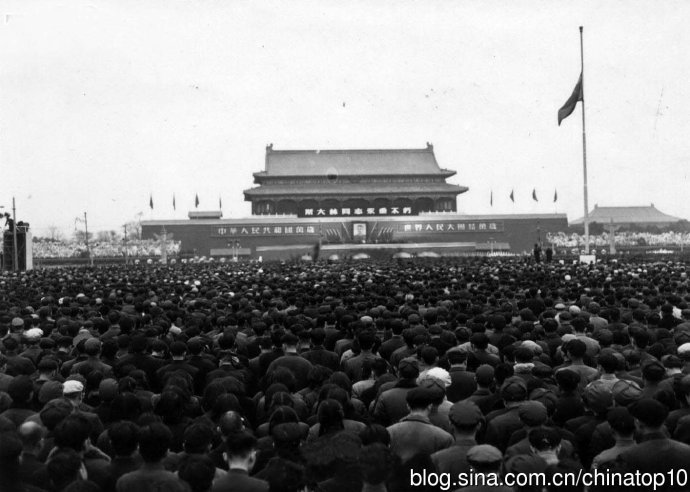
On March 6, 1953, the central government ordered everywhere in China to lower their flags to half mast from March 7th through the 9th. Every mine, factory, school, military unit, enterprise, and government office was not supposed to hold any banquets or recreational activities. On March 9th, all government offices from the county level on up were supposed to hold mass memorials. This picture shows the mass memorial held at Tiananmen at 5 p.m. Mao, Zhu De, and many other top leaders were in attendance. In that morning’s People’s Daily, Mao said Stalin was “A modern genius, world communism’s great leader… He represented our entire era.”
Much past discussion of Mao’s laudatory words about Stalin have centered on if he wanted to become not just China’s Stalin, but the new Stalin of international socialism. But, I will not discuss this matter here. What interests me is what memorials for Stalin reveal about the imagination of China’s place in the world and burial practices at the time.
These ceremonies organize Chinese burial practices around clock time and the solar calendar. There is a specific time when the entire nation is supposed to mourn, not in solitary, not as a family, but as a mass group remembering the life of a individual, not because he was Chinese, nor because he was an individual, but because he was the head of socialism worldwide. At memorials, participants thus became part of an imagined community of socialists committed to carrying on the international revolution, whose leader had just passed. To show their respects, every place across the nation is also supposed to not just bow their heads in unison at mass memorials, but lower the symbolic head of the nation to half mast for three days.
For more on the relationship between death, memorials, and socialism in Mao’s China, see this post.


 Everyday Life in Mao's China