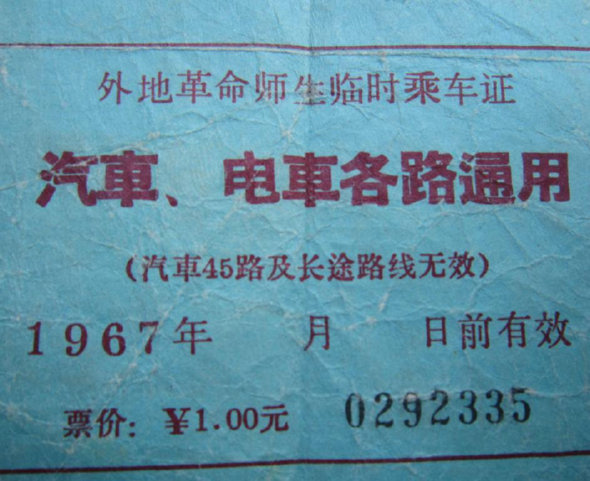
Transportation Passes During the Exchange Revolutionary Experiences Campaign , China 1966-1967

IF IFFrom these passes, it is possible to see a few different aspects of the Exchange Revolutionary Experiences Campaign as well as transportation more generally in China at the time. People in and outside China often portray this campaign as a chaotic free-for-all on China’s buses and trains.  These passes show that transportation authorities at least attempted to restrict travel.
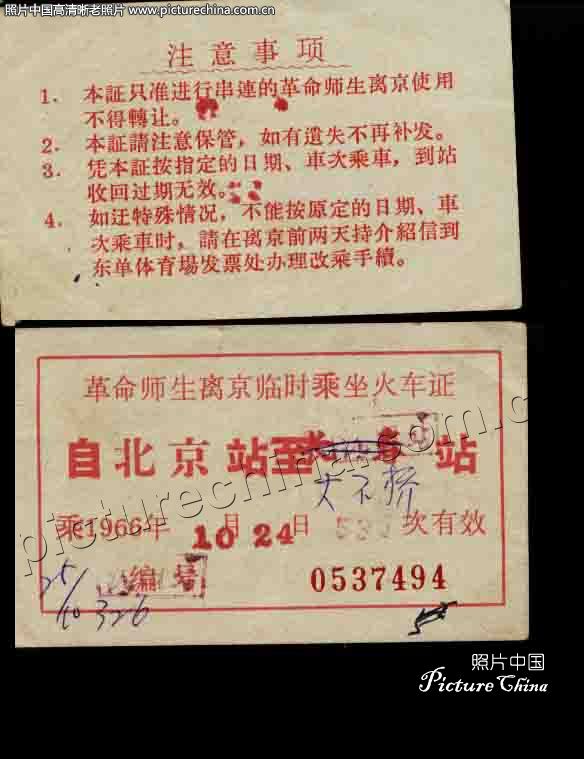
The passes were non-transferable. If someone lost their pass, they had to go with a letter of reference to a specific location to acquire a new one. Tickets were also only usable by a specific category of person – “revolutionary students and teachers” – and they could not go, wherever they wanted, at least not according to their pass. A pass was valid for a specific kind of transport, in one city or from one city to another. Passengers could only use them on a certain day, and sometimes only on  a specific train number. 

In this last regard, these passes were similar to ration coupons for grain and cotton cloth, which were only usable at a certain commune, county, province, etc. They had a specific spatial range in which they were valid and had value. Beyond that, they were useless.  I would guess that, like with ration coupons, all country transport passes existed, but only someone with considerable authority could have probably acquired one. 

The quote from Mao Zedong on the reverse side of the ticket shows that all ticket holders were supposed to have one issue on their minds. They all had to be concerned about important national matters and realizing the Cultural Revolution to the fullest extent. No matter where they were, no matter what they were doing, no matter what day it was, they should consider the nation and its revolutionary future during their travels.

On a more general level, these passes display how the Party managed transportation at the time. No tickets have names. Only in 2012 did the National Railroad Bureau start to print names and ID numbers on train tickets. The government did count how many passengers took trains though, as evidenced by the large numbers on the corners of the passes. On the other hand, railroad managers did not keep track of where passengers sat: passes have no seat numbers. It only became possible to purchase assigned seats in the early 70s. In the late 60s, railroad passengers could choose what class of seat they wanted though, with a choice between hard and soft seats.

watermark (1) watermark (2) watermark

Comments are closed.

Create a free website or blog at WordPress.com.

Up ↑